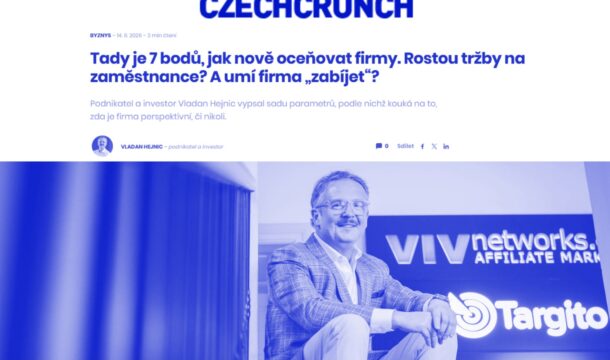
Ekonom: A Company Needs a Different Boss at Every Stage. There Is No Ideal CEO

In issue 40 of the weekly Ekonom, published on 8 October 2026, I wrote in the Management section about which CEO fits which stage of a company, when a founder realises he has become the obstacle, and how to choose the person who replaces him. The full text follows below.
I was looking for a CEO for one of my companies and I was clear about what he should look like. Passionate, analytical, willing to give the business everything: time, energy, even health and the hours he should have spent with family and friends.
That is exactly what I expected of myself, so I applied the same template to every candidate who sat across the table from me.
The result was exactly what it had to be: almost nobody was good enough. The mistake was not in them. It was in the fact that I had a single template and applied it to everyone.
I do not want this to sound as if I have since become wise. But one thing I have clarified well over those years, after meeting several hundred founders, managers and CEOs.
Searching and Building Are Two Different Crafts
It is simple to draw up a list of qualities of a good CEO. Visionary, driving force, empathetic leader, hard executor. The problem is that such a list assumes the company is always the same. It is not.
Steve Blank puts it precisely: “A startup is a temporary organisation searching for a repeatable and scalable business model. A company is a permanent organisation that operates such a model. Searching and operating are two different crafts.” And I add: they require two different people.
I once divided people into journeyers and finishers. Journeyers love the road and fear what comes once it is done. Finishers want things completed.
With CEOs I have a similar divide, just a different axis: finders and builders. A finder can identify what the market actually wants. A builder can construct a company capable of delivering that every day, at scale, even without him. I consider myself a finder.
In the early stage of a company you need to sacrifice almost everything. If you do not give all your free time and then some, it usually does not work.
In the Early Stage You Sacrifice Almost Everything
In the early stage you also need to sacrifice almost everything. If you do not give all your free time and then some, it usually does not work. That tenacity is what drives a founder to polish the foundation so that the product or service has any chance at all.
At the same time, I am not telling anyone to sacrifice health, relationships and family for it. There lies the difference between a choice and a price nobody asks of you and that cannot be returned.
I know this direct, hands-on mode of the early stage mainly from my own skin. The founder goes into detail, does not delegate entire blocks of the company and is not afraid that from the outside it looks like micromanagement. That is fine as long as you know how long you will stay in that mode. The disaster is staying in it five years longer than you should have.
My Strongest Signal in the Early Stage: Does He Ask Why?
When I talk with a founder in the early stage, I notice one single thing. Whether he asks “why”. Not “what should I do”. Not “how do you do it”. But: “Why did you do it this way? What mistake did you make and why did you think at the time there was no other way?”
Whoever asks “what” takes away someone else’s answer and blindly copies it into a different context. Whoever asks “why” takes away the reasoning and uses it again.
Whoever asks “what” takes away someone else’s answer and blindly copies it into a different context. Whoever asks “why” takes away the reasoning and uses it again, even when the situation is different.
A founder who asks why a lot develops significantly faster. He does not have to pay his own “tuition” for every lesson, because he works off part of the cost through other people’s experience.
When a Founder Realises He Is the Obstacle
This is the part I learned the most from myself, and I admit it with humility.
The early stage will eventually end. A moment comes when the product is validated by the market and the company starts to be built. And from that point the finder has to be far more sensitive to the question of whether he is starting to slow the company down.
A good CEO recognises early when he is no longer fulfilling his role. And usually it is because he cannot do it. But what a person cannot do is generally something he does not want to do and resists.
You can see it in concrete things. Decisions made too quickly where the company now deserves deliberation. Fast dismissals and people swaps. Resistance to rules from someone who never needed rules himself, while every mid-sized and larger organisation necessarily does.
Two Lessons I Had to Learn
I realised this most sharply when a person who decides completely differently from me came into the company alongside me. I am used to deciding fast, often on instinct, and for a long time I considered that a strength everyone should have.
He needed data, time to think and a clearly formulated brief. It took me a while to understand that this was not a weakness. He was doing exactly what the company needed at that stage and what I was unable to give it myself. Deliberate decision-making brings an organisation the calm you do not need in the early stage and cannot do without in the next one.
The Second Lesson: The Flaw Was in the Brief
The second lesson I brought on myself as the owner. I once gave a hired CEO a clear goal: double the revenue. He delivered it precisely.
But to make those numbers work, things that should have gone outside our company were pushed through it, and the partners we were supposed to grow through in the long run started to see us as their competition. It was not the manager’s mistake. It was a flaw in the brief I approved myself. I got exactly what I ordered, including what I did not order.
Within three years of founding, half of founders were no longer in the CEO role. In the vast majority of cases it was not their own decision.
Most founders will not admit this. Noam Wasserman studied 212 American startups and found that within three years of founding, half of founders were no longer in the CEO role. In the vast majority of cases it was not their own decision.
That statistic does not say founders are bad. It says the transition between stages is real, arrives sooner than they expect, and few of them notice it first.
When someone admits it, there is a better path than waiting to be replaced. He starts looking for a new CEO, steps back into the owner role and takes one area, the one he understands and enjoys. It is not a demotion but a role change in which he is useful again.
How to Choose and Lead a New CEO
At the stage when a company is run across several levels, I value completely different people than in the early stage. I value those who agree with me on the final goal but define the path themselves, within the limits of ethics and basic rules.
Freedom in method and firmness on goals are not opposites. They are two sides of the same agreement. Whoever wants freedom without commitment to results does not want to be a CEO. He wants to be an employee.
I have also noticed that I bear differences worst in people with whom I otherwise have a lot in common. When a hired CEO gives the company a similarly large share of his time and energy as I once did, I recognise it immediately and I value it.
But that is exactly what also makes me more impatient about the few things where we differ. I expect him to be the same as me even where that is no longer desirable. I had to learn to distinguish: similarity in commitment does not mean we should also agree on method. Where we differ is usually the space for what I cannot do myself.
When I Become His Subordinate
When I then take one area myself and become his subordinate in it, only one approach works for me. Checking out loud whether what I am doing is a brief or a goal, and what I am supposed to do about it. Then I do it and it is done, with no interventions outside the agreement.
The outcome remains his responsibility, otherwise it is not his company to run. A founder carries weight in his company that he does not lose by stepping down from a role. He can silence the CEO without ordering anything, it is enough that he says his opinion out loud. I have to watch for this every day and it does not happen by itself.
How I Recognise a Good CEO
When I summarise it into the signals I watch for myself:
- Asks why, not what. The reasoning behind a decision interests him, not a ready-made recipe to copy.
- Knows what stage the company is in. And can say whether he belongs in this stage or not.
- Seeks out those who have been through it. More experienced people, their mistakes, their bends. And is not afraid to ask those who did not make it either.
- Decides so he can look in the mirror in the morning. Ethics is not a separate chapter. It is the filter every decision passes through.
- Can say “I cannot do this”. And does not hide behind resisting it or putting it off.
- Recognises when he stopped delivering before the team does. This is, in my view, the hardest and rarest quality of all.
- Agrees on the goal and justifies his path. He has his own idea of the steps and can work through them.
- Is predictable. For the owner and for the team. Demanding people can handle. Unpredictability they cannot.
Notice that there is not a single quality among them of the type charisma or the ability to carry a crowd. It simply turned out that they misled me for years.
In Closing
The hardest part of this reflection for me was not drawing up the list. It was admitting that for a long time I was not measuring people by it, but myself.
Today I see it differently. I am not looking for the best CEO. I am looking for the one who fits the stage the company is currently in, and who will recognise himself when that stage ends.
The article was published in the weekly Ekonom no. 40/2026 on 8 October 2026 in the Management section. Published here: https://ekonom.cz/c1-67941360-firma-potrebuje-v-kazde-sve-fazi-jineho-sefa-idealni-ceo-neexistuje
A longer version of this reflection is on the blog: I Was Naive. I Thought Everyone Was Like Me.