
An Innovation Centre Cannot Be Built in One Electoral Term
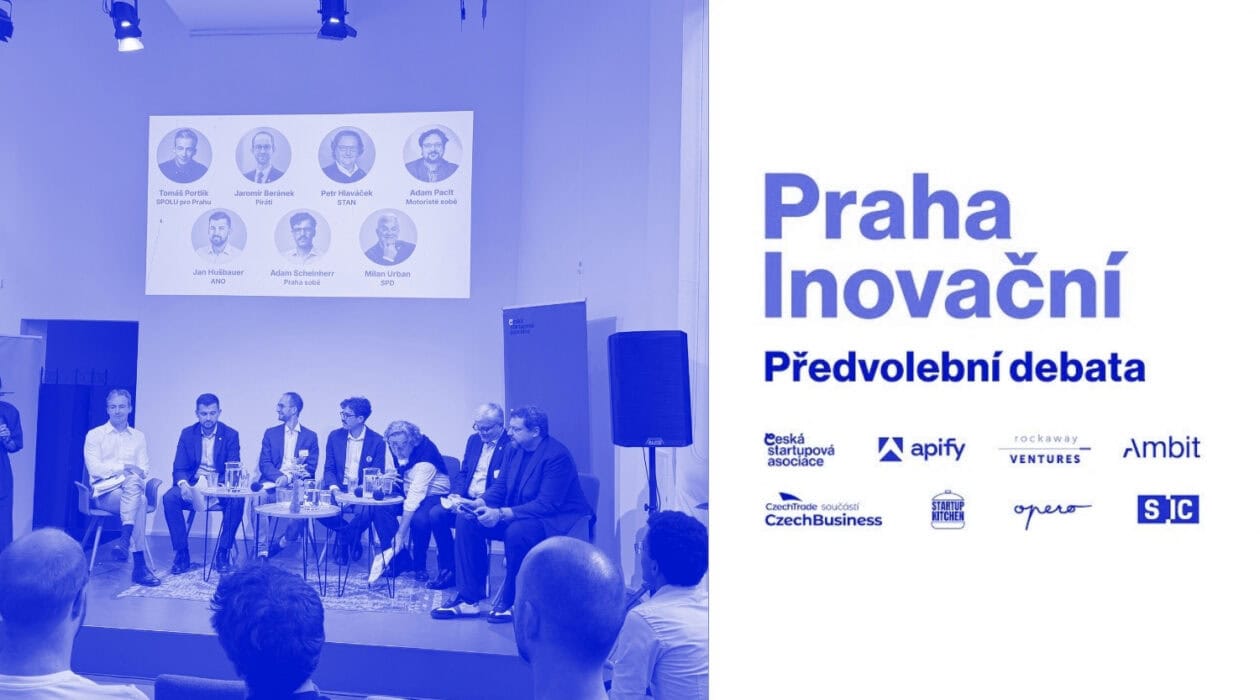
At the invitation of the Czech Startup Association I attended a pre-election debate where seven candidates for Mayor of Prague presented programmes focused on innovation and startups. Seven parties, seven programmes and, at the end, a promise of three concrete things they would deliver by 2034. I went to hear what they would offer startups. I left with notes about something else entirely.
There Were Finders and Builders in the Room
Two weeks ago I wrote about two types of CEO and about finding the one who fits the stage the company is currently in. A finder is still working out what the market wants. A builder can turn that into a company delivering every day, at scale. In that room the divide showed itself with almost laboratory clarity.
Most of the candidates were finders. They talked about vision, about 2034, about how the character of the city would change. They used strong words and they spoke at length. I do not mean that as criticism. A pre-election debate is exactly the format that rewards finders, and anyone without a vision has nothing to say in it.
But there were builders there too. They spoke less. No big words. They stubbornly repeated the basic principles of management: who will be accountable, how it will be measured, who will run it managerially and where the money will come from. One of them summed it up by saying that innovation has to be given a clear owner, space and responsibility.
In a debating hall that does not sound appealing. In a company it is the one thing that turns an idea into a result.
Then it occurred to me that my pair of types is not enough for politics. Something is missing from it that in business we take for granted.
A Manager Assembles His Team. A Politician Is Handed One.
You also arrive at a company unable to replace the entire staff on day one. You have to play for a while with the cards your predecessor dealt you. But sooner or later you can choose your people.
A mayor has no such option at all. Voters mix the team for him. He sits down in a coalition with people from other parties, with different ways of thinking and different life experience, and some of them carry unsettled scores from previous terms. He cannot replace any of them, and with all of them he has to deliver something to us, the voters.
So it is not about being a visionary, nor about being a manager. It is about being a team player and bringing together people you did not choose around a single question: is this good for Prague or not?
What They Agreed On: Prague Should Be a Facilitator
Despite all the differences, all seven agreed on one thing. Prague should neither run nor own innovation. It should build an environment in which startups have no reason to leave for other European countries or for America, meaning it should offer space, infrastructure and conditions.
In my view that is a correctly calibrated ambition, and for a fairly unsentimental reason. It was said in the debate that the city influences only around two percent of its own revenue, specifically property tax. When a company comes to Prague and pays its taxes here, almost nothing flows to the city from that. Prague therefore has no built-in economic motivation to attract companies. All the more reason to choose that role deliberately.
And the pressure is real. Petr Šmíd, an investor representative who spoke at the debate, pointed out that the technology sector loves concentration and that Central Europe has no room for several such hubs. Warsaw has had a Google for Startups campus since 2015. Paris has Station F, Stockholm has Norrsken House. Prague still has no single place where founders, investors and research meet.
The Strongest Point Was Made the Most Quietly
But when we talk about where Prague already has strength today, the most interesting thing in the entire debate was not a vision and it was not a building. It was procurement from municipal companies.
Prague owns some of the largest public companies in the country, with budgets in the billions. Those companies have problems they have to solve, and the way they write their tenders decides whether a small innovative firm can even reach them. When a buyer insists on completed references and deployed installations across the country, no startup will apply. It has nothing to prove something it has never done.
The debate produced a concrete case where the city did it differently. The Technical Administration of Roads used preliminary market consultations for paid parking zones, opened up the brief and did not demand a finished concept. A company applied offering roughly half the budget using AI, plus something extra: not just monitoring parked cars, but also the condition of road surfaces and traffic signs. Apparently four startups in total passed through the city this way and today they are large companies.
The Objection That Measures the Wrong Thing
An objection was immediately raised that cannot be dismissed: deliveries for municipal companies are often so customised that they do not scale anywhere else.
That objection is factual. It just measures the wrong quantity.
For a startup the value is not in the margin on that contract. It is in the reference it then takes out into the world. When you are negotiating entry into a foreign market, a documented implementation with a large European public buyer opens doors that a grant of the same size will never open. It was said in the room as well: a reference project from Prague as a reference for global expansion. This is something Prague can do immediately, within its own companies, without a building permit and without a new budget.


The Legislative Backbone
The second thing happening outside the city and, in my view, underrated: the Czech Startup Association did not stop at organising debates. It saw through the preparation of a startup act, agreed it with the government, and the law is now going through the legislative process.
That is work nobody sees and it takes years. Hats off to Jiří Vicherek and his team, and of course to Martin Jiránek. They managed it in a matter of months.
The act rests on a startup tripartite, meaning regular meetings between the government and the innovation sector, held jointly with the association and attended by founders and investors. The government is aiming for it to take effect from mid-2027.
A criticism was raised in the debate that Prague has no representative in that tripartite. Let us be precise: neither does Brno, nor any other city. The tripartite is a government platform and local authorities by definition do not belong to it.
Even after that correction the question still seems a good one to me, just posed differently. Prague is the city where most Czech startups are founded, where the vast majority of investment takes place and where more than a hundred thousand students study. Is anyone asking it what belongs in that law? And did it speak up itself?
Why One Innovation Centre Works and Another Does Not
What interested me most, though, was a diagnosis raised almost in passing during the debate: the difference between innovation centres in the Czech Republic apparently lies not in money, but in who founded them.
I tried to check it and it holds up better than I expected.
The South Moravian Innovation Centre came into being in 2003 as an association of legal entities with six founders: the South Moravian Region, the City of Brno and four Brno universities, namely Masaryk University, Brno University of Technology, Mendel University and the University of Veterinary and Pharmaceutical Sciences. In Central Bohemia, the innovation centre emerged in cooperation with research institutes in the region.
The Prague Innovation Institute came into being on the platform of Prague alone.
I do not want to blame everything on a single cause. Twelve million crowns a year for operations, as was repeatedly stated at the event, is a dismal amount for the ambition of building a capital city innovation centre, and the management of the institute in previous years was dismal too. Both are true and neither excuses the other.
Twenty-Three Years and Thirteen Hundred Companies
And now the numbers, because without them this would be mere moralising. JIC has been running for twenty-three years. The budget it works with has in recent years hovered around forty million crowns a year, roughly three times the twelve million cited in the debate as the annual operating budget of the Prague institute. In that time more than thirteen hundred companies have passed through it. In 2004 it was Y Soft, in 2010 Kiwi.com through the StarCube accelerator, later came its own investment fund, the first FabLab in the country and a creative hub in the centre of Brno.
None of that came about in a single electoral term. Kiwi.com arrived seven years after the founding, and what we today call the Brno ecosystem is the result of two decades.
But what interests me most is that first figure. Six founders against one.
When more founders enter a company, it usually slows down every decision. But it forces one thing a solo founder does not have: you have to justify your intention to someone before you launch it. And then you cannot back out of it simply because the mood or the leadership changed. An institution founded by a single owner for himself has nobody to listen to, and nobody to defend it once that owner is replaced.
So it is not primarily about the budget. It is about the number of founders.
That is why the idea raised in the debate, and supported by part of the room, makes a great deal of sense to me: connect innovation support in Prague and the Central Bohemian Region into one strong centre and build it so that universities and research institutes are involved from the start.
Servant of Two Masters
The toughest objection of the entire evening was immediately raised against that idea. Two political representations, two local authorities, a shared supervisory board, and a person expected to serve two masters who ends up satisfying neither.
That objection is legitimate and I respect it. Even so, I think it is posed wrongly.
Prague and the Central Bohemian Region are not competitors. They are communicating vessels that together account for a large part of this country’s economic output. One has universities, students, investors and conference facilities. The other has research institutes, space and experience with building an innovation centre that actually works.
A company looking for somewhere to build a laboratory does not worry about the boundary between a region and the capital. It worries about whether it will find people, space and partners there.
This is not about politics. It is about Prague and the Central Bohemian Region together being better and more attractive for startups than either of them is alone.
And with that the reflection returns to where it started. An innovation centre meant to stand alongside Brno or Warsaw in twenty years cannot be built in one electoral term. It will survive only if the next city leadership does not scrap it because somebody else founded it. Which means the decisive qualification is neither vision nor managerial competence.
It is the ability to reach agreement with people you did not choose.
In Closing
I left that debate rather encouraged. Agreement that Prague should be a facilitator was found across the parties. The concrete items, meaning open tenders from municipal companies, the startup act and the link-up with the Central Bohemian Region, are on the table and none of them requires a miracle.
What remains is the hardest part, and it is precisely the thing we have no trained muscle for in business, because we usually assemble our teams ourselves.
The best candidate need not be the one with the best vision. It will be the one who can assemble a team from people he did not choose and keep it focused on one question for longer than four years.
We will not learn that from election programmes. We will learn it only afterwards.


