SZ.cz: Running an e-shop is a science – and it comes at a cost. Build yourself a “crew”
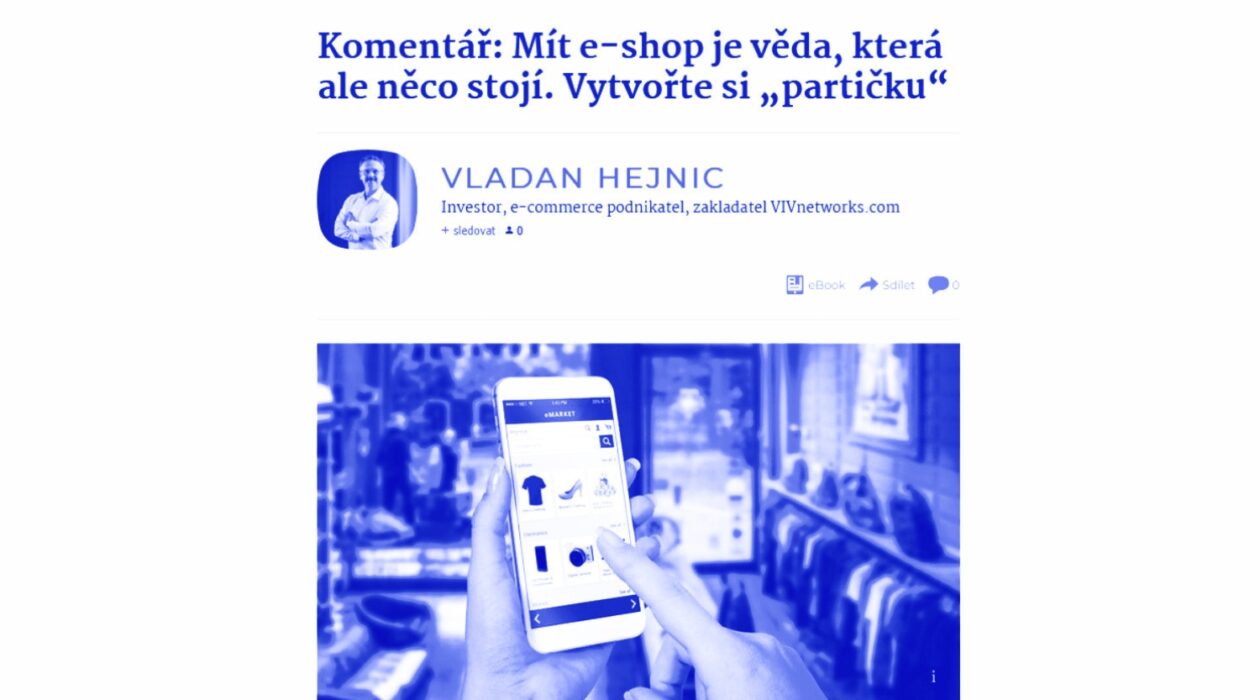
E-commerce growth has stabilised. Revenues are not growing as fast, because there is greater focus on unit economics and overall sector profitability. We do see that the biggest players often maintain high turnover even at the cost of losses – because they want to be first in line for buyers during consolidation and profit from a future sale of the company. At the same time, the structure of what drives the industry forward is changing. Segments around supplements, longevity, sustainable health and self-care are growing rapidly. These new consumer trend areas are driving at least part of the growth across the entire sector.
On the other hand, a growing threat to Czech e-shops is the increasing willingness of consumers to shop across the EU. It is not unusual for the exact product you need to be available for immediate delivery from a German e-shop – and often cheaper – while in the Czech Republic you wait weeks. The Czech market is smaller than the home market for most manufacturers and distributors. On top of that, Chinese marketplaces are entering the scene and will very soon behave – and actually function – as local sellers. They are building logistics centres directly in the Czech Republic. The question remains how they will deal with European legislation, but their influence will grow.
What is driving e-commerce forward and what is holding it back
What can help Czech e-commerce achieve growth and economic stability? No single tactic has ever saved anyone long-term. It is always a combination of steps. Technical progress driven by AI already plays an important role – both in serving consumers and in internal efficiency. Artificial intelligence today helps with personalisation, product recommendations, customer support and data processing. But few people look at the broader social shift and which areas are becoming important for society. And it is precisely these changes that then filter through into a field as technical as e-commerce.
It is no longer true that Czech e-commerce stands primarily on technical skills. The e-commerce world is becoming more complex and more creative, with marketing gaining in importance. Every year brings new tools and ways of doing things. The pressure on knowledge and team size grows – which does not always align with the economics of an e-shop.
The cost spiral grows, but profitability may not move
And then come the saviours in the form of large multinational companies that promise to solve “everything” for you. Google is a prime example. Just look at the simple line of reasoning: I do not know how to evaluate my marketing activities and investments, so Google offers a free analytics tool that shows it all clearly. Great – but then you also invest in advertising through Google. Google earns around 75% of its revenues from advertising. It is no surprise then that the way Google attributes which advertising channel brought the visitor who ultimately placed an order conveniently favours Google sources or organic traffic. Yes, Google also offers more advanced methods, and if you want to and know how, you can find out everything correctly. But this is where these large companies return to the core issue: people simply do not have time to learn more complex technologies and processes.
It is a spiral – you spend more to grow, but profitability does not improve. Those who refuse to play this game invest more in education and experimentation. It requires greater effort. I can see this in our data at VIVnetworks, where we hold 80% of the e-commerce market in performance advertising and generate CZK 10 billion in sales through this channel across the CEE region.
Those who want to avoid the spiral choose independent tools to measure their marketing spend. They then mix their investments into a more diverse range of traffic sources.
The spiral spins most dangerously where you are directly competing for a visitor you want to bring to your e-shop and you are outbidding for them in an auction. The highest bidder wins. That is why Chinese marketplaces, co-financed by the Chinese government with practically unlimited resources, hit everyone so hard. You simply cannot compete. Many e-shops have therefore turned to performance advertising, where they are not competing directly with others, and where the skill lies more in communicating with partners and coming up with interesting collaborations.
Building communities requires a long-term approach
And this brings us to something key: building communities. I will say upfront: this is not for everyone. It requires a long-term approach – but it is worth it. We have largely learned to work with customers long-term. But we keep oversimplifying it – and over time, the typical tactics stop working. I can see this in our clients’ email marketing data. We look at millions of transactions and observe which tactics lead to repeat purchases and greater loyalty. We need to personalise messages more and select better products for next-purchase recommendations. This is where AI is incredibly helpful.
If you create a feeling – an emotion – that the customer is special to you, that you respect and advise them well, you gain them into your community. For a while. This feeling must be consistent. Create it at every point of contact with your brand and e-shop.
Reviews as part of the customer community
Working with reviews is also part of this approach. Research has proven how much brand affinity increases when someone credible recommends it. Sharing the experiences of real users is an asset that every e-shop must cultivate – not only for retaining existing customers, but also for acquiring new ones who do not yet know you. The entire review industry is experiencing enormous growth. Brands use it to launch new products, commissioning campaigns with real testers. Reviews set the right expectations for future customers. Reviews are regulated by EU law and must always be authentic reviews from real users. AI is used here to improve the efficiency of the whole process – not to create or alter the content of reviews.
Partner communities: a less explored phenomenon
Something that is still not widely explored in the Czech Republic is building partner communities. Larger e-shops focused primarily on volume tend to have little experience with this. Building partner communities is based on a fair and collaborative relationship.
As large e-shops grow, they lose sight of the detail of what is happening in different customer segments. Partners who provide their audiences with content in the form of reviews, product comparisons, discount promotions or trending products know their audience very well. From discussions they know what their audience is interested in and what motivates them to buy. They see from data what gets a positive response. They are often highly sophisticated companies – almost IT firms – that implement AI to improve their operations far faster than a large e-shop.
These partners have remarkable insight into customer decision-making within their – sometimes very specific – target audience. The goal is to build a long-term collaboration model where the partner supports the e-shop under clearly defined commercial terms agreed in advance. I know data from thousands of such collaborations and during difficult times in the Czech economy I have seen how these partners sustained e-shop growth.
The future of e-commerce rests on AI and communities
If you ask about the future of e-commerce, it will not be about a single tool. The winner will be a combination of technological efficiency through AI and long-term stability through communities. That is the axis on which Czech e-commerce can grow even in a more demanding environment.
Original source: seznamzpravy.cz